Sansevieria zeylanica, earning its keep in the window of a Toronto clothing boutique. Image © In Situ Plants.
A Kentia palm provides a backdrop for a handbag in a Toronto showroom's display window. Image © In Situ Plants.

I laid out in another post some of the ways plants can improve office and other interior spaces; rectifying poor air quality, reducing stress and improving focus and attention were some of the major benefits, all of which could of course be employed anywhere to optimize indoor environments.

As it turns out, there is also a good amount of data supporting the fact that retailers in particular have the potential to directly increase revenue through the addition of plants in their spaces.

Plants notably improve the customer experience in retail settings, and draw more customers, keep them around longer, and cause them to interact more with the space.

This study from the Vienna University of Economics and Business explored how the addition of plants and other natural features affected the movement and behavior of shoppers in a mall, and found that plants alone increased the inflow of people by nearly 25%, as well as increasing interaction with the space and with other people by more than 33%, creating that much more opportunity for sales. When coupled with other naturalistic elements such as water features the numbers become even higher, making a great case for both, though of course plants are a little less elaborate and more practical for most spaces.

They then go on to invoke this study, which notes that businesses on streets with ample trees rated substantially higher in customer perceptions of merchants and product value and quality, particularly in the case of specialty goods.

How is all this possible? The answer lies in the biophilic instinct, which I’ve gotten into here already, but which is basically humans’ innate need for affiliation with other living things, developed as we evolved alongside other forms of life. Proximity to natural elements helps us to feel grounded, secure, and at home, and indeed we do tend to surround ourselves with these: from houseplants to city parks, plants have figured largely in the way we have lived our lives since at least the beginning of written history.

Biophilic store design, then, is the incorporation of natural elements such as plants to a space to address this instinct in order to improve and enhance the consumer’s experience and ultimately translate this into increased revenue. Live plants are, of course, not the only natural element that could be used to satisfy this; they are, however, as close as one is likely to get to nature in most indoor settings.

For us this is yet another affirmation of the benefits and value of plants in retail spaces; we’ve seen first hand and heard from our clients how, for instance, people come in off the street just to have a look at the plants, only to more often than not shop the store.

And while we feel that any organization can benefit from interior landscaping services, it would appear that retail establishments have an opportunity to profit directly from the addition of plants to their spaces.

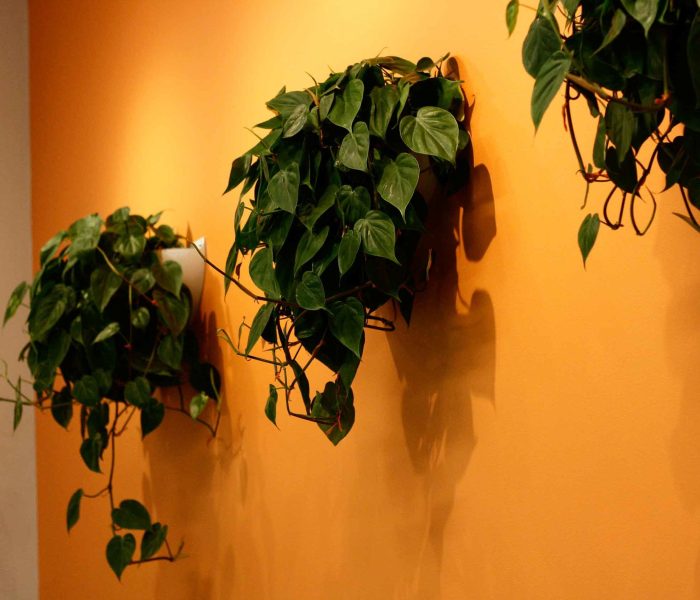
The classic Philodendron hederaceum, perfectly contrasting an orange wall. Image © In Situ Plants.
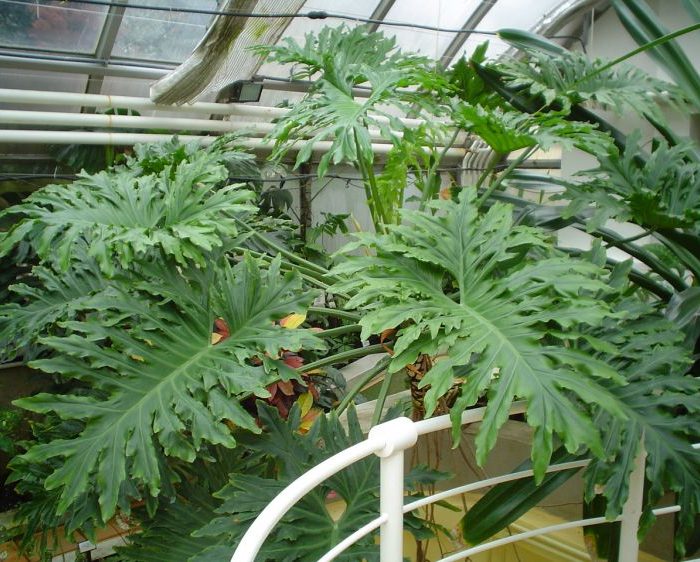
Philodrendron bipinnatifidum, playing at being a tree. Image © Jan Richtr; retrieved from the Biological Library website.
The aptly named Philodendron gloriosum, in its glory. Image @ In Situ Plants.
Philodendron erubescens, the quintessential tropical climbing vine. Image retrieved from fcpn.net.

Philodendron has to be one of my favourite genera within one of my favourite families of plants; the Araceae. They range from miniature specimens great for terrariums to veritable trees. There are several species quite common in cultivation, and several others that are not impossible to find; most are exceptional, hardy specimens in the interior landscape. Care is generally the same across the genus, though the ones in commercial cultivation are generally hardier than the rarer species coveted by serious collectors.

All appreciate bright indirect light, though some species such as P. bipinnatifidum are happy with as much light as you can give them indoors, while others such as P. cordatum can hang in there in spots too dim to grow much else.

Nearly all species in the genus are at least occasionally epiphytic, with most growing above the forest floor, and so appreciate a fair amount of air at the roots; a nice open mix that still holds moisture well is appreciated by these plants. They certainly do not appreciate being waterlogged, and I like to let the surface of the media dry down a bit as an indicator of when they need a good drink again. Humidity is appreciated, but most will soldier through without.

As noted above, there is a lot of variety within the genus; what follows are descriptions of a few of the species more or less common in cultivation. And remember, this list is only scratching the surface of the large and impressive list of interior plants from the Araceae, the family to which Philodendron belongs, and to which Anthurium, Monstera, Epipremnum, Syngonium, Alocasia, Zamioculcas and Spathiphyllum also relate (to say nothing of Cryptocoryne, Bucephelandra, Lagenandra, Anubias [all grown in aquariums] as well as some of the less common genera that find themselves indoors here such as Raphidophora).

Philodendron ‘Rojo Congo’ and other self-heading varieties

These are generally big plants suitable for larger spaces; ‘Congos’ will quickly reach 5-6′ in diameter. The stems and petioles of ‘Rojo Congo’ have a reddish colour to them, and the leaves are a deep green. This one likes brighter indirect light; it is otherwise quite hardy and resilient to drought. Definitely a great choice for a quintessential tropical look, it is an impressive plant that contrasts well with green foliage plants. There’s a ‘Congo Green’ out there that lacks the red colouration, but it’s less popular. Other self-heading varieties include such fanciful names as ‘Imperial Red’, ‘Prince of Orange’ and ‘Moonlight’, and these are for the most part more compact than ‘Congo’.

Philodendron hederaceum

In my opinion one of the best vining plants for the indoors, the humble P. hederaceum now has several incarnations that are all quite nice. People have been growing this one for a long time, and justifiably so; it is extraordinary resilient, and can tolerate low light and missed waterings very well; we often use it in place of the more commonly seen pothos (Epipremnum aureum) because I prefer the leaf shape and more delicate stems. Bright indirect light is best, and will help the plant produce nice large leaves.

Plant breeders have developed a chartreuse variety (I’m unsure of the official name), and a cultivar named ‘Brazil’ (which features a light green stripe down the middle of the leaf), both of which contrast marvelously with the true species and offer a little extra colour in a planting. But perhaps the best variety of this species is one with velvety, almost iridescent foliage and a purplish colour to the undersides of the leaves, which is a naturally occurring variety which probably has a name, but which I won’t try and determine here (wading through the taxonomy of this species is frustrating, to say the least).

Philodendron bipinnatifidum

Say the name above five times fast and I’ll buy you one: this interesting species has to be one of the largest in the genus, though it most often hits the shelves as a young plant. Commonly sold under the cultivar name ‘Selloum’, this species grows a thick, almost trunk-like stem, and indeed can stand on its own until it reaches considerable height, although it is adapted to grow tightly against the sides of proper trees via thick aerial roots. These make wonderful specimens in humid greenhouses when given enough room, and would fare well in larger indoor settings provided they are able to get enough light, though for some conspicuous reason they’re not often seen here either too often anymore. They don’t do so well (and tend to look terrible) in spaces where they’re up against a wall or in a corner, and do even worse when light is inadequate, so try and avoid the temptation to buy one of these unless you truly have the space to dedicate to one.

Philodendron gloriosum

There are several species of Philodendron (and several more in the related genus Anthurium) which look similar, foliage-wise, and thank heavens; gloriosum is an apt a name as could be hoped for. Beautiful large, velvety, deep green foliage with prominent white veins make this species stand out dramatically, and though it’s a bit ungainly in smaller spaces I don’t think I’d ever pass up the chance to use one if I could.

This species is interesting in that it seems to be terrestrial in nature, and wants to spread across the ground, which makes it a bit challenging to maintain in a pot, but certainly well worth the extra effort. This would definitely be a great choice for a larger bed in good light, where it could grow unimpeded and get really well established. Similar-looking but less common species such as Anthurium clarinervium are more self-heading in nature and are more easily contained, though these may be a bit more temperamental regarding humidity.

Philodendron erubescens

There are many cultivars and hybrids from this species, and it really is the quintessential climbing Philodendron, in my books. You’ll see these most often grown on a totem, and a well-grown specimen is impressive indeed, though plants on totems are a little tricky to keep looking nice over the long term (what to do with them when they reach the top, for example?). The sheaths which cover the emerging leaves are often red, and provide a nice contrast to the rich green of the leaves. Several of these in a row can make a great room divider, and are a great way to add a bit of height to a planting without breaking the bank, as these plants grow quickly under optimal conditions and are inexpensively produced by growers. They will also grow well as hanging plants in larger spaces, though all they want to do is grow up something, so a totem really is the most natural way to display these. (The same could be said of P. hederaceum above as well, really.)

In all, I generally find Philodendron species to be hardy and adaptable. I have noticed that they’re susceptible to thrips (see this post for more info on those little buggers), but past that and sometimes mealybug or spider mite to a small degree I’ve not seen too much afflict them. Too much water or too little light are the ones to watch for; otherwise, they’re very rewarding to grow, especially when they get huge.

Bonus: Species Suitable for Terrariums

On the other side, as though there wasn’t already enough diversity in the genus, there are also a few species that stay small enough to allow their long-term use in terrariums. One goes under the name Philodendron ‘Wend-Imbe’, though I’m unsure of the accuracy of this name. At any rate, the one grown in terrariums gets to only about 8″ tall, and features narrow lance-shaped leaves. Another is Philodendron ‘Burle-Marx Fantasy’, which is a small (in its immature form, which it easily retains) climbing vine with beautifully patterned foliage, and which was discovered in the collection of Mr. Roberto Burle Marx, a Brazilian landscape architect. If one gets at all serious about terrariums they will see these available from time to time, and they should definitely jump on either should the opportunity arise, as they lend a lush foliar touch to the tropical terrarium. (There are several other members of the Araceae which are also great terrarium candidates due to their diminutive size such as Pothos scandens, Anthurium gracile and Syngonium rayii, but this list is meant to be about Philodendron specifically, so I’ll leave these for now.) Try them out.

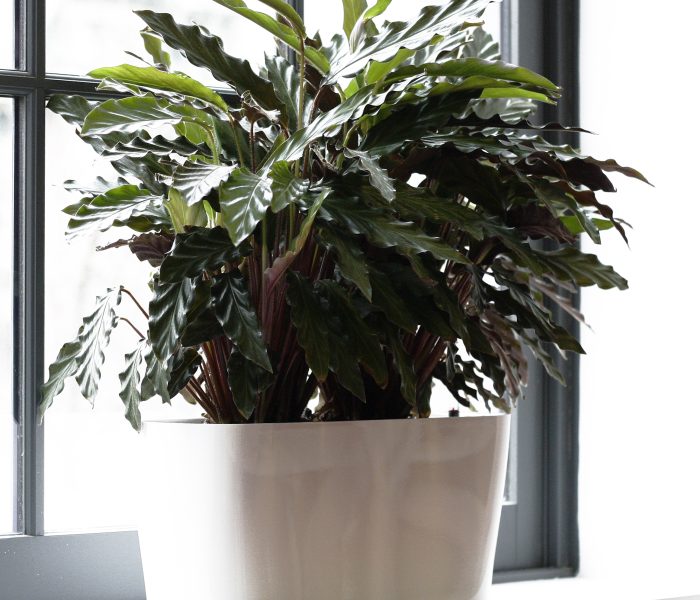
Calathea rufibarba, a beautiful yet rarely grown species with fuzzy, scalloped leaves which are a deep green above and purple below. Certainly a little more interesting than a Spathiphyllum or other similarly-sized plant, this species garners a good amount of attention. Image © In Situ Plants.
Anthurium superbum, a species with beautiful bullate leaves that thrives in bright indirect light. Image © In Situ Plants.

There are an estimated 400,000 species of plants on earth. While this includes species such as giant marine kelp, leafless parasitic plants, and a slough of other ones not ultimately suitable for indoor cultivation, there are a significant number which will do quite well in an interior setting provided a few basic conditions are met, and certainly more species than are typically seen indoors.

It seems then a disservice to our clients, our own industry and plants in general that most companies seem to prefer to play it safe with the tried-and-true varieties that we’ve all become so accustomed to seeing. They’re about as common as dirt, as the saying goes, and, besides the fact that they (hopefully) have been grown as premium interior specimens and not hastened out the greenhouse door in the fashion of so many of the houseplants sold to the consumer market (the subject of another forthcoming post, I’m sure), there’s not really much to differentiate them from the plants that people are growing on their own at home, or at least that they’re so used to seeing everywhere that they don’t even notice them anymore.

It’s a disservice to clients because, while presumably done with good intentions in order to spare clients the sight of an ailing plant should anything go awry (most of these are very tough to kill [or at least they die slowly and relatively gracefully], and perform fairly predictably), it doesn’t really deliver a tremendous amount of value to the client: certainly they will get the physical benefits of having plants indoors (these benefits were touched on in this post), but the aesthetic and biophilic benefits of plants seem to me somewhat dependent on the plants being engaging and actually noticed, instead of looking like furniture as they so often do. And why have something commonplace when something extraordinary is just as much cost (on their part) and effort (on our part)?

It’s a disservice to our industry for several reasons. As I noted above, to the untrained eye these species, even if they’ve been better grown, look nearly indistinguishable from the ones that can be bought for a pittance at a big box store or wherever; it is challenging to justify the price point for them when someone thinks that they’re the same as the ones they saw for a quarter of the price up the road, even if they get the whole spiel about quality, etc. The other side to this is that many people grow these plants in their home themselves; why, then, would they pay us to do it? Yes, we can do a much better job (hopefully!), but it’s just another aspect we need to justify to the customer. Granted, there are some situations (extreme low light, for example) where only the bulletproof plants will do, but in most situations there is likely something more unique that could be used.

Lastly, it’s a disservice to plants (not that they care): what better way to share a passion for all things green than to try and show the public as much of that world as we can? There’s just so much out there that it seems strange to restrict ourselves to the commonplace when we’re in the business of bringing life into our clients’ spaces; certainly showcasing the extraordinary biodiversity that the plant kingdom has to offer is an effective way of doing just this.

Plants are able to do so much for us, and technology now makes it easier to keep species with particular requirements happy without any additional work (the Calathea above would certainly be trickier without the sub-irrigated planters it’s in; it’s relatively easy to grow so long as it doesn’t go dry). Vertical gardens allow the perfect growing environment for plants so uncommon in cultivation that they don’t even have a common name; the combination of ample water and high humidity makes a huge variety of plants available to the vertical gardener. What a shame then to see so many large, high-profile projects populated by pothos and other common plants when the whole of the tropics could have been the designer’s oyster.

In Situ challenges all in our industry (growers, local wholesalers and interior landscaping firms) to venture off the well-trodden path of Dracaena and Schefflera and step into a world rich in plant species which can grow our industry and the public’s love and appreciation for plants indoors.

Feeding damage caused by thrips to a pothos leaf before it has fully developed, resulting in distortion and necrotic patches. Regrettably out of focus image © Plantscape Designs, Inc.; image retrieved from their blog.
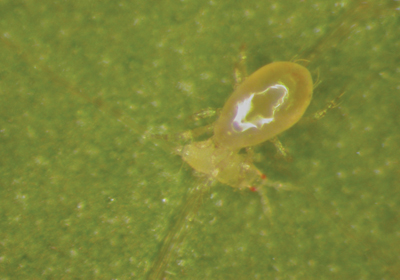
Amblyseius cucumeris, a mite predator of thrips, in a moment of glory. Image © Rosemarije Buitenhuis; image retrieved from an article on thrips on the Greenhouse Canada website.
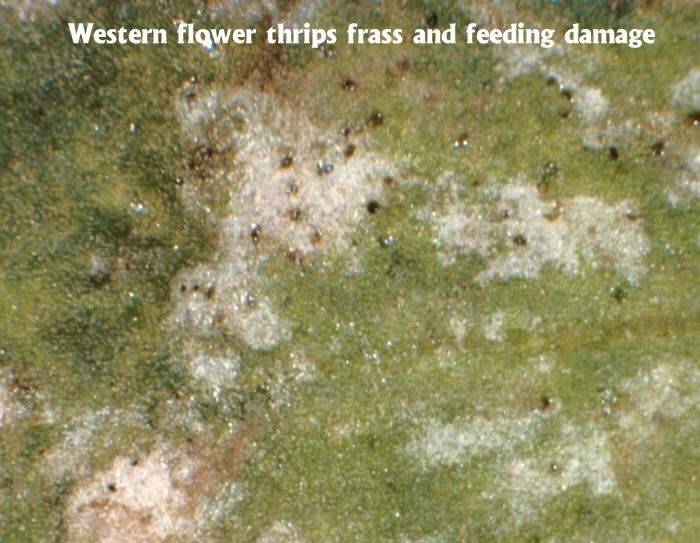
Feeding damage and feces left behind by thrips, the rude little buggers. Image © the respective photographer (there are several credited on the page); retrieved from the University of California, Riverside

When one reads about pests in the interior landscape, spider mites, scale and mealybug are the most often mentioned, and with good reason: these creatures can, if conditions are right, completely overwhelm a plant, literally sucking the life from it. Even if they don’t, they can cause plants to be unsightly, and, in the case of the latter two insects, can cover the plant and the immediate area with sticky honeydew which is a bitch to clean. The signs of their presence are usually fairly obvious: spider mites create webs which can cover leaf surfaces and their feeding damage gives foliage a speckled appearance; scale will populate the foliage and stems with their dark, bumpy selves, and mealybug will crowd leaf axils and stems with their cottony badness.

And then there are thrips; they are small enough that most of the time you won’t know they’re there, and the damage they inflict on plants is often confusing and can lead one to believe that something else is responsible. And often when I’m assessing a problematic plant and mention them, people will frown and ask, ‘What are thrips?’ Hence this post.

Thrips is a large family of insects, many species of which are serious agricultural pests. (And yes, the singular and plural pronunciation and spelling is the same.) Because they have the ability to reproduce so rapidly, they can quickly develop resistance to chemical insecticides, making them a serious nuisance.

Because they feed primarily on new growth (including leaves, flowers and fruit), the damage they do is often caused before this new growth develops fully: flowers and leaves then open with distorted shapes, necrotic patches and streaks that can resemble disease, mechanical damage or nutrient deficiency. They can also feed on matured foliage, leaving behind silverish patches which in some species can become bronze-coloured or corky with time. They are, as I mentioned above, quite tiny, and when hidden deep in a flower bud or the like can be practically invisible. Knocking the plant part while holding it above a white sheet of paper will often dislodge a few and reveal their presence, and they do leave dark little globs of feces near feeding damage as well.

t is not merely enough for them to be sneaky, tiny, and voracious; they are also incredibly mobile. I have visited sites where every single plant on an entire office floor was afflicted (granted, it was stocked mostly with thrips’ favourite food, but still). They are capable of flight and also of being carried by the breeze due to their tiny size (not that this is as much a problem indoors). They also breed at a pace that would make a rabbit blush; they can complete the cycle from egg to breeding adult in as little as two weeks if temperatures are high enough to permit it.

This latter fact is one of the main challenges with their management by chemical means; as they reproduce so quickly, they are able to just as quickly develop resistance to insecticides, and thus these only offer a measure of control for a short time before they are useless. Irresponsible use of these chemicals by producers (failing to rotate chemicals, calendar spraying, and incorrect technique) have not helped the situation, and in fact, probably the most widespread of these beasts in Canadian ornamental horticulture, the western flower thrips, is now resistant to most chemical insecticides.

But before your despair causes you to throw your scarred old pothos into the compost, wait: there is hope in the form of biological control. There are many predators of thrips in nature, and several are able to be commercially raised for use in controlling them. Natural Insect Control, Inc. of Stevensville, Ontario is our most local option here in Toronto, and offers several of these in varying increments, the most common and economical being Amblyseius cucumeris, a predatory mite with a healthy appetite for thrips. This is a great solution if you’re not anti-bug in general (you’ll be intentionally releasing thousands of mites into your plants, after all), though to their further credit they are also very small and innocuous. I won’t get into the importance of knowing a little bit about the life cycle and natural history of both thrips and these mites in order to have optimal success with this technique; that’s a whole other blog post, at least. Suffice to say that it’s definitely a good option, particularly if you have many afflicted plants or what you’re trying to save is of high value (A. cucumeris are reasonably priced, by biological control standards, but certainly cost more than the average plant that one might buy at a garden centre or the like). There are several other thrips predators available to consumers such as Orius insidiosus and several other mite species, but as mentioned above, A. cucumeris is the most economical.

Another option is using products containing spinosad; these have only recently become available to consumers in Canada, so far as I know. They contain spinosyns, which are compounds which were discovered by fermenting a bacteria found at a rum distillery in the Virgin Islands(!); you can read the dry version of that here. Spinosad is wonderfully effective at controlling thrips, as it happens; I first read about it perhaps six years ago as a good tool against thrips in people’s orchid collections, and it has certainly knocked down populations that I’ve treated. There have been reports of thrips developing resistance to spinosyns, so applying sparingly and rotating with another product and/or in conjunction with a thrips predator so that the spray is used less often would help to minimize this effect.

Some products containing spinosad are approved for organic agriculture, which is enticing, though it should be noted that it is very noxious to bees, and so care should be taken with the product in that regard. The LD50 for this stuff is absurdly high compared to pyrethrin, a derivative of chrysanthemum flowers which is used in over-the-counter insecticides, which effectively means that it’s safer (the LD50 actually means that it takes whatever the number is worth of milligrams of compound per kilogram of an animal’s body weight to kill 50% of a population of said animal; a bit strange, but that’s the standard): according to the LD50, presuming you’re as sensitive to this compound as mice or rats and near median human weight, you would need to ingest 310 grams of it in order for it to be fatal; a feat, to be sure.

There are other non-chemical options available to commercial producers which are effective, and which seem to be trickling down and becoming available to the rest of us: the entomopathogenic fungus Beauvaria bassiana has been used as an ingredient in commercially available products for at least several years, and consumer-packaged products are available for order online from out of the country. There is not yet such a product being sold on shelves in Canada, so far as I know.

If you have these pests, you’ll likely be wanting to do something, as they can overwhelm a plant if they like it enough. The pothos pictured above is a common example of a member of the family Araceae, which all the way across the board has been a magnet for thrips, in my experience: Monstera, Philodendron, Anthurium, Spathiphyllum; all of these have fallen prey to the tiny rasping mouthparts of these miniature beasts, while other plants have grown in close contact without sustaining so much as a nibble. There are other susceptible species amongst common and rare indoor plants, and they love many species grown for cut flowers such as chryanthemums and gerbera daisies, to which they cause huge economic damage every year in production greenhouses; tap your bouquets over a sheet of white paper before you set a vase full near your houseplants!

Because their life cycle is so rapid, treatment will need to be fairly frequent in order to ensure they do get knocked down. Biological controls should be released at regular intervals, as many predators such as A. cucumeris feed only on younger thrips and can’t manage the adults (O. insidiosus certainly can, and it’s a joy to watch under magnification, but these guys don’t come cheap).

So that’s the story about thrips; controlling them can be a challenge, so have a close look at any plant you’re thinking of taking home, because you know what they say about an ounce of prevention…


Anoectochilus formosanus, a beautifully-patterned small species of orchid which grows terrestrially in leaf litter in its native habitat, and which loves the moist humid surroundings of a terrarium. Image © In Situ Plants.
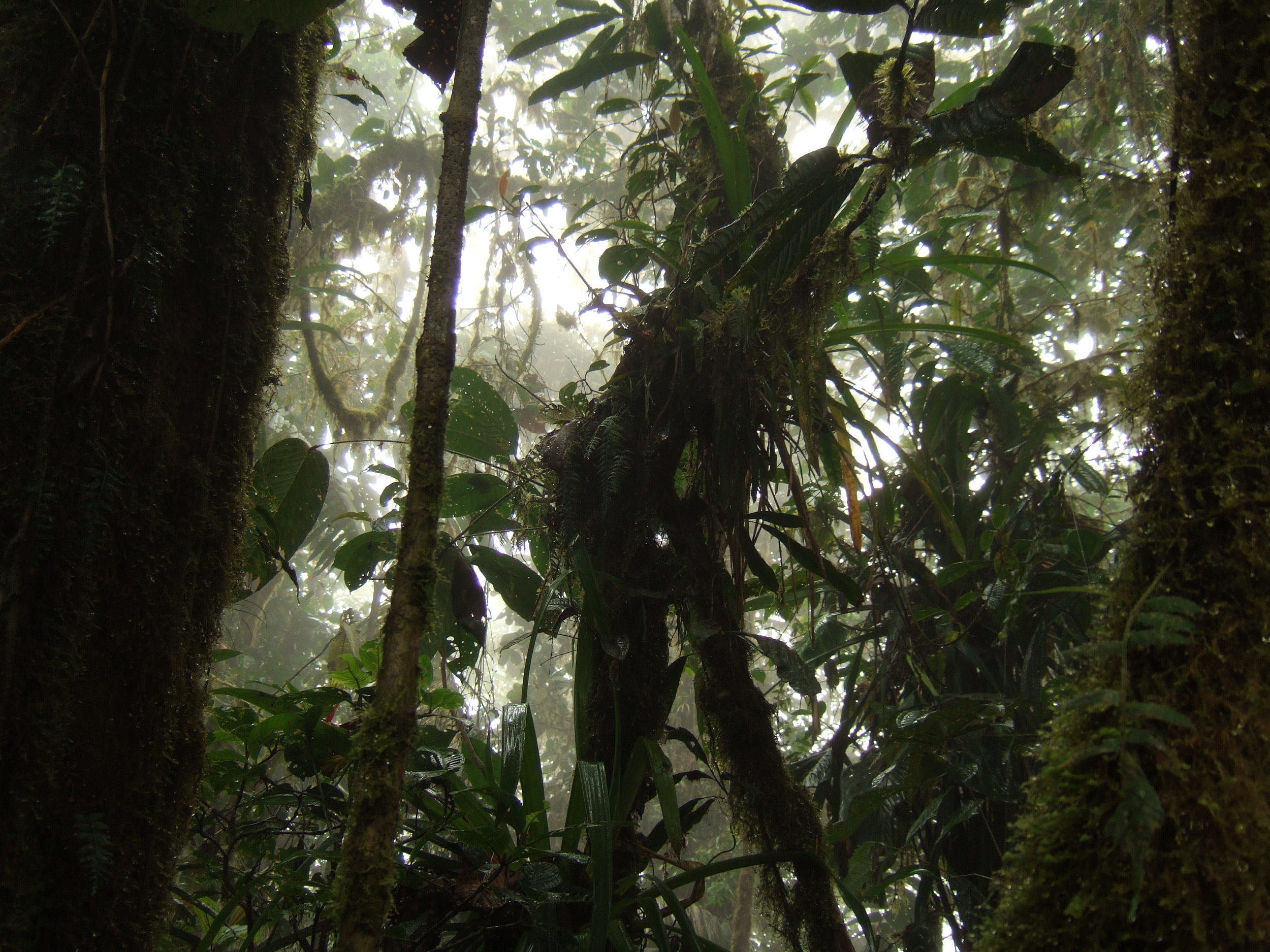
The tropical understory; a wealth of interesting species often better suited to the confines of the humid terrarium than the oft-toted succulents. Image © In Situ Plants.
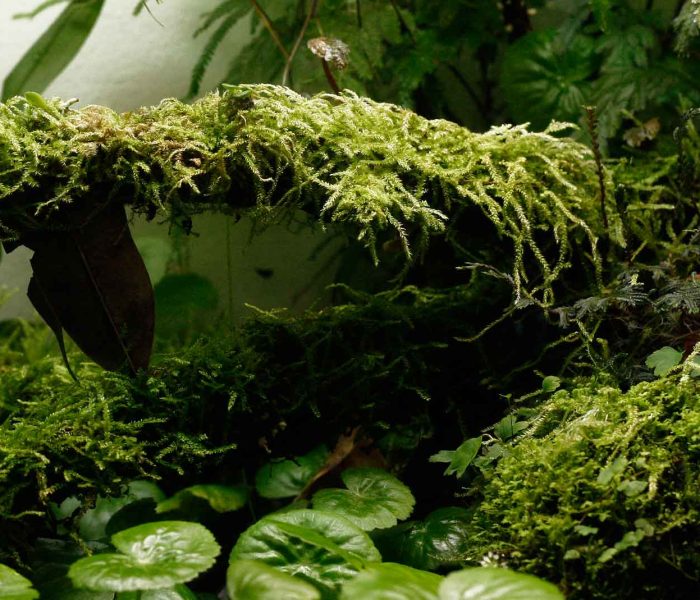
Mosses, to me, are some of the most lush and beautiful plants one can grow, and they do best in a humid terrarium. Image © In Situ Plants.
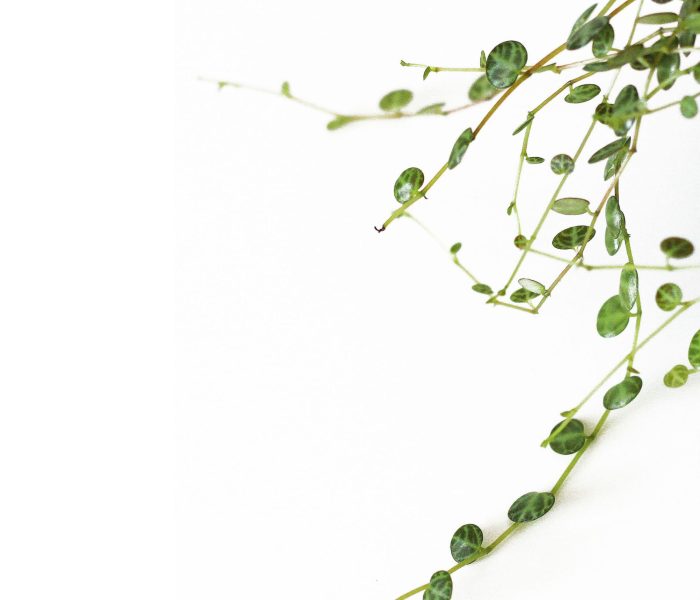
Peperomia prostrata, a long-standing terrarium favourite which is also quite cute and succulent-looking. Image © In Situ Plants.

You’ve likely read me hint before about my disdain for the current craze in succulent plants, and succulent terrariums in particular. Don’t get me wrong: I’m glad to see an interest in plants in general, and I have nothing against the plants themselves, really; there are a lot of interesting plants that are classified as succulents, displaying a huge variety of shape, colour, and texture, which I suppose is the appeal.They have a reputation of being hard to kill, which I’ll admit is partially true; they grow easily enough when conditions are favourable, and if they are not, most of them are at least slow to decline if pretty much left alone, though improper care can hasten their end, especially via overwatering. They are inxepensive, though (particularly the cute young plants that florists and the like get in), and so are easy to replace when one knocks off.

But are people satisfied with this? Isn’t the whole thing about keeping plants to try and keep them alive and doing well? I’ll readily admit to having killed a plant or two in my time (not usually for lack of trying), but one of the first things I think about when I find a plant I like the look of is whether it’s suited to my growing conditions, and, for me at least, most succulents are patently not. They require (for the most part) very bright light, which is an immediate turn off for me personally, and should be for most people I meet who profess to be ‘really into succulents right now’, most of whom don’t have a window with decent exposure, let alone the solarium or greenhouse that would really allow these plants to do their thing.

These plants end up being stuck in a seashell, a shot glass, or some other kitschy place, or worse yet, a terrarium, where conditions are not exactly optimal; these plants are adapted to arid regions, and most require very bright light, free-draining soil and good air movement to do well, and without special considerations these can be very difficult to achieve in a terrarium environment, which are by design retentive of moisture and humidity.

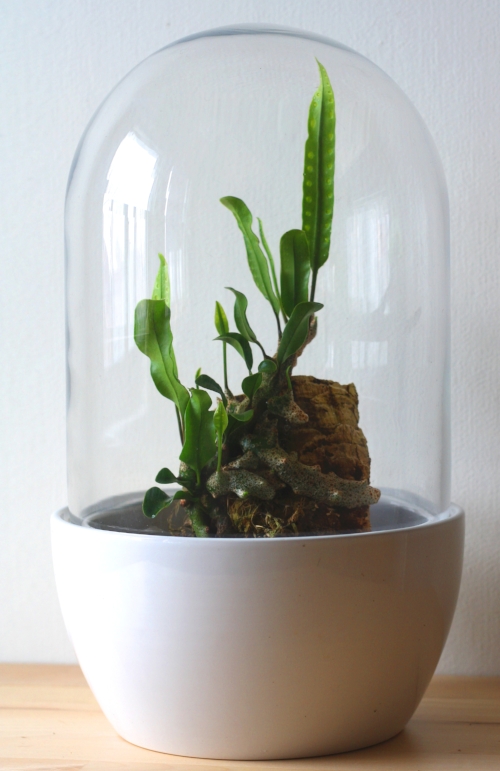
Seeing as how one might have a glass vessel around after succulent disasters of one kind or another (if not, they’re readily available from many stores now in various shapes and sizes, though of course any glass or otherwise transparent container will do, really), why not give one a go again with plants that are perfectly at home therein? The really nice ones (such as the orchid to the right) can take a little digging to rustle up, but there are many fine species which can be found without too much trouble and with which one can have some rewarding success with terrarium gardening. Because the terrarium should really be a less intensive and more problem-free way to keep plants indoors; soil moisture is held much longer, so issues with forgetting a watering will not be as severe, and most plants will benefit from the extra humidity and reward the grower with larger, vibrant-looking foliage while at the same time avoiding the many foliar maladies that come with dry indoor air.

This was the original purpose of the terrarium, after all; Wardian cases have been around since the Victorian age as a way of keeping exotic tropical plants alive indoors, which was the style at the time. Ferns and the like were and are appreciative of the shelter provided by these glass enclosures, and we now have better technology which allows us to have seamless (and leadless!) glass enclosures for these plants, which makes them all the more attractive while still being quite functional.

What are the prerequisites for a good terrarium plant? First and foremost the plant needs to be adapted to the conditions approximated by a terrarium, which typically consist of lower light, consistently moist soil, higher humidity, lower air movement and limited space, though all of these variables can be controlled to some degree. Fortunately there are many plants who are right at home in such an environment; think of the tropical forest understory, where the light is dim and the air and soil are often very damp indeed. Many species can be found either growing directly on the ground or else epiphytically on the lower portions of trees, and these are often the best suited for terrarium life.

There are plenty of blogs and articles out there that list suitable species, so I won’t bother with one here. Be wary, though, as some of these lists are not entirely well thought out and some of the listed species may eventually grow quite large (relatively speaking); when starting out, working with a larger container will help keep things manageable without needing too much maintenance to keep things from being cramped. Do a little research and find out the maximum size of any prospective species and it will save you trouble in the long run. There are a great many true miniature plants which will stay small for their entire lives, but they are often not available through most retailers, who instead often sell juvenile plants in small pots because they’re cute and inexpensive. An alternative might be creeping or stoloniferous plants, for example, like Pellionia, Pilea, Episcia and others, which are pretty easy to find; their size is very easily managed, for they stay low to the ground and need only be trimmed when they start climbing the walls of the terrarium. There are many upright plants which will stay reasonably short in stature that pass through the garden centres and florists’ often enough, too, so familiarize yourself with a few of the plants from the terrarium-friendly plant lists beforehand and keep your eyes peeled.

There are in fact whole enterprises geared towards selling terrarium-friendly plants (though not so much in Canada, unfortunately); in the USA, Black JungleJosh’s Frogs and Glass Box Tropicals are three that are very popular amongst dart frog hobbyists, who build elaborate natural planted enclosures for the species they keep in captivity. Not all of us have access to these places, of course, but their stock lists do serve as a handy reference for plants amenable to the terrarium environment.

A couple tips on setting up and maintaining a terrarium: first, use good quality soil for your terrarium and I guarantee better success than using the dirt from the garden centre (I’d written a little bit about terrarium soil near the bottom of this post): one that allows better aeration and increased longevity will make plants much happier over the long term. And keep up on your watering, but notice that a little water will go a long way; one of the benefits of a clear container is that you can watch the water you apply migrate and spread out into the soil. Do this once or twice while paying attention and you’ll get a sense of how much water it will take to keep things just right. And if you’re a heavy-handed waterer by nature, do not despair; there are plenty of plants that don’t mind wet feet. Plants sold for aquariums, for example, are often riparian species that will do marvelously planted in consistently moist to wet soil and kept humid, and the selection in the trade now is better than ever.

Second, keep that thing out of direct sunlight, especially if it’s without any ventilation holes; if you’ve ever been in a greenhouse on a sunny day you’ve experienced the greenhouse effect, where heat is trapped and accumulates within. This effect works within the terrarium, too, and plants inside can easily be cooked if temperatures are allowed to become extreme. If you’ve picked the right plants, bright indirect light should be the most you’ll need, and many will tolerate deep shade fairly well.

Third, do your homework! If you learn a thing or two about a particular plant’s origins and habitat you’ll be able to make an educated decision on whether it’s a good candidate for the terrarium or not; a simple search online with the species name appended with the word ‘habitat’ will bring up a fair amount of information in most cases. Even cultural tips such as ‘enjoys high humidity’, ‘keep out of direct sunlight’, and ‘keep moist but not wet’ are all valuable clues to the suitability of the prospective species. Knowing your plants a little better also increases the richness of keeping them as a hobby, I feel, so don’t be afraid to nerd out a little.

If you are hellbent on succulents and not having much luck with them inside glass containers, perhaps a dish garden may be a better direction to go for your diminutive landscapes; this will allow for better air movement and the option for higher light in order to achieve greater success with these plants. And of course all of this is not to say that a succulent terrarium is impossible; I’m sure there are people out there who can pull it off (long-term, I mean; anyone can stuff some plants in a jar and put a photo of it on the internet). But the terrarium environment is really best suited to tropical species which will respond positively to those conditions, and if it’s the particular form of succulents that appeals to you, there are many other plants which are succulent-looking in nature but which do hail from tropical forests. Many Peperomia are quite succulent, and most are very well-suited indeed; P. prostrata above has to be one of my all-time favourites. There are some caudex-forming epiphytes such as Mymecodia and Hydnophytum (which are profoundly interesting in their own right due to their mutualistic relationship with ants in nature; read more about that here) which are delightfully rotund at the base and often a little spiny, Cryptanthus and other bromeliads certainly conjure the rosette forms of Echeveria or Haworthia, and the list goes on and on, so give something new a try and have another look at the terrarium; there’s so much out there waiting for you.

album-art

Tungahua I - Bosque Protector Los Cedros

00:00
album-art

Trogon Creek - Bosque Protector Los Cedros

00:00
album-art

Amanecer Cerca del Observatorio - Bosque Protector Los Cedros

00:00
album-art

Clearing - Bosque Protector Los Cedros

00:00
album-art

Aves en el Bosque Secundario - Bosque Protector Los Cedros

00:00

I thought that there might be some interest in these, and they’re certainly not doing anyone besides myself much good just sitting on my hard drive. When I last had the pleasure of visiting the tropical forest I recorded many, many hours worth of soundscapes from different areas of the Bosque Protector Los Cedros, a biological reserve in Ecuador covering 17,000 acres of mostly untouched wilderness in the lower part of the Chocó biogeographic region, one of the world’s biodiversity hotspots and home to a staggering number of species of flora and fauna, many endemic to the region.

Below are several recordings, all about an hour in length. They were taken from several locations and form something of a picture of this type of forest in the middle of the (relatively) dry season; though life doesn’t seem to slow down much in the rain there, it certainly becomes more challenging to record it well. My efforts at makeshift umbrellas made of Anthurium leaves were enough to protect my equipment from the many downpours, but the acoustics left much to be desired. All of these recordings were made with me present, perched a little way further down the trail but still within eyeshot of the area so that I could attempt to document the wildlife I was recording (I must have looked positively ridiculous flipping furiously through the field guide The Birds of Ecuador, which contains something like 1600 species, after some tiny hummingbird or another).

I will unabashedly confess that this area of the world is what sparked my interest in plants, and I believe that In Situ has come into the interior landscaping industry directly from these forests, with our boots still muddy; our interest in working with more unusual and exotic species, replicating natural habitats, creating impromptu natural history lessons and trying to recreate indoors that feeling one gets when surrounded by a forest almost violently alive and brimming over with some of the most amazing plant species on earth is a direct result of this early exposure to the rainforest of South America.

Mostly tranquil, sometimes raucous, often hilarious (although maybe you had to have been there), these recordings (to me, at least) capture much of the feeling of being alone in these primeval forests; so lush, vibrant and vigorous, the plants seem to grow visibly as you watch them, and there is an abundance of life everywhere you rest your eyes. I hope that they have some measure of transportive effect: take them for a spin and let me know what you think.

If I hadn’t temporarily lost my notes I’d use the space here to name the goodly number of bird species one can hear in this recording; when they turn up I will add them. The avian fauna makes up a large percentage of the readily visible creatures one can see when walking (or in this case, sitting) the trails at Los Cedros. (I should say relatively visible; even the brightest coloured-ones are somwhat cryptic in the riot of life that is this type of forest.)

If you have this recording on at appreciable volume though a decent set of speakers you may notice a dull booming sound, which I didn’t know what to make of when I’d heard it out there. It wasn’t until I got back to camp and heard the news that the Tungurahua volcano near Baños (nearly 200 kilometres away) was erupting did I put two and two together.

This recording was named after the bird which can be heard calling beginning at about twelve minutes into the recording; a beautiful bird which I had seen infrequently but had never heard call before I captured it here.

Water is at the heart of this forest, and indeed this reserve’s mountain streams and massive rainfall serve as the principal watershed for the surrounding communities, which are noticeably hotter and dryer than even a little ways up the hill.

El Observatorio is a small open space atop a hill on the ridge that overlooks Los Cedros. Perched at about 2100 metres, it’s a great place to sit and, weather-permitting, look out over the great untrodden wilderness below.

It’s a bit of a hike to get there, much of it along the sopping-wet ridge where is seems always to be raining or have just finished raining; epiphytes abound, and it’s a great place to find orchid species, among them species in the genus Dracula, of which several are unique to the area.

This recording was taken at dawn after having spent the night on said ridge with a couple other fellows and a prodigious amount of rum. Dawn was certainly not as painful as it could have been had I woken up elsewhere, as I’m sure you’ll agree after listening.

Empty space is somewhat hard to find there, but I was able to find a clearing at set up shop for a few hours, which is where this recording was taken. By the way, the white noise that’s present more or less in all of these recordings is the sound of the river, which was something of an annoyance, but easily forgivable.

This is a pretty minimal recording, really, (with the exception of the one or two parrot-flock flyovers) but I feel like you can hear a bit of tension; it was threatening to rain (again) for its duration. A few of the forest-edge bird species make their appearance here.

Another recording taken just after dawn in an area of more secondary forest, where epiphyte density is a little lower and where sound seems to carry a little better. If you’ve ever been up and about at dawn (couldn’t blame you if you haven’t) you know that it is a busy time for our feathered friends, and is a general changing of the guard in the tropical forest from the night to the day shift, so one tends to hear a good solid mix of different creatures at this time, from frogs to insects to monkeys and lots of things in between.
Epiphyllum oxypetalum, grown here epiphytically on a date palm, and showing a huge flush of flowers that can reach nearly a foot wide. Image © Kiwoncello; image retrieved from Compagna del Giardinaggio.
A small colony of young Sinningia pusilla, growing comfortably in a 2" nursery pot, with blooms nearly the size of the plants. Image © In Situ Plants
Columnea microphylla being shown at a Toronto Gesneriad Society meeting. Image © The Toronto Gesneriad Society; image retrieved from their website.
Stapelia gigantea, shown here with a ridiculous amount of huge stinky flowers. Image © gardenmaniac; image retrieved from the Dave's Garden website.
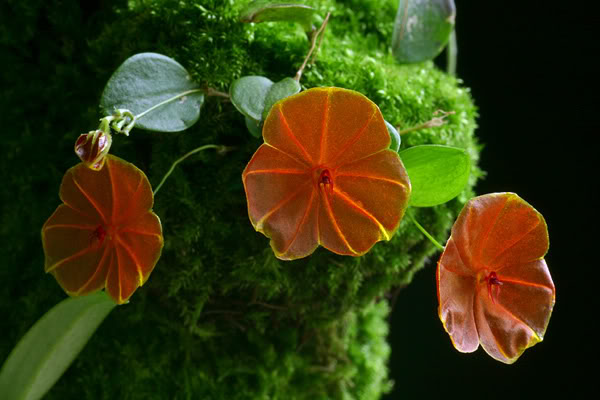
Lepanthes telipogoniflora, a tiny species with a huge name and a huge flower. Image © Thomas; image retrieved from the Species Specific forum.

What follows below is a short list of several species that have a wonderful aspect to their morphology; they just happen to have ridiculously large flowers, either in fact or in proportion to themselves (perhaps it’s the same as in ants and other smaller creatures, which are able to lift many times their own body weight, that only smaller plants can grow a flower that is larger than the rest of the plant). These are all species that can be grown indoors, though some are more challenging than others.

Epiphyllum oxypetalum and related species

One of the many plants with the common name ‘queen of the night’ (and also known as ‘orchid cactus’ ‘Dutchman’s pipe cactus’ or ‘night-blooming Cereus’), E. oxypetalum is an epiphytic cactus native to Mexico and a good part of Central America. It produces dinner-plate sized white flowers that open for a single night and are heavily scented. This plant grows easily enough in a pot or hanging basket, and will bloom well enough indoors if care is up to snuff. It is pretty rambly by nature, and can get awfully large if you give it room, though it is easily pruned to shape, and at least the stems are spineless, which makes brushing past one in a tight space not as uncomfortable as it might be with some of its close relatives.

Sinningia pusilla

I know that terrarium gardening has been a fad of late, but I fear that the concurrent popularity of succulent plants may cause people to be frustrated by limited success with terrariums (this being for the simple fact that succulents by their very nature are not good candidates for terrarium culture); more on that whole thing later, but in the interest in promoting terrariums as an actually quite easy way to grow plants and have them do well (read grow well and flower), I would like to make Sinningia pusilla the poster child of terrarium gardening.

This species has everything to recommend it; they are adorably tiny (leaves are around 3/8″ long), have fuzzy, somewhat iridescent foliage, and, best, throw huge (relative to the plant, at least) pale tubular flowers. They self-pollinate and are quite prolific, able to quickly start colonies of seedlings that form an attractive ground cover. They also are quite easy to grow if provided with one thing above all: humidity. Enter the terrarium; given the added humidity, these plants will flourish when the soil is kept reasonably moist; if allowed to dry too far or too long, they will go dormant, reducing themselves to a tiny tuber to await the return of more favourable times. They are also fairly undemanding of light, which sets them worlds apart from succulents and other plants commonly toted for terrariums.

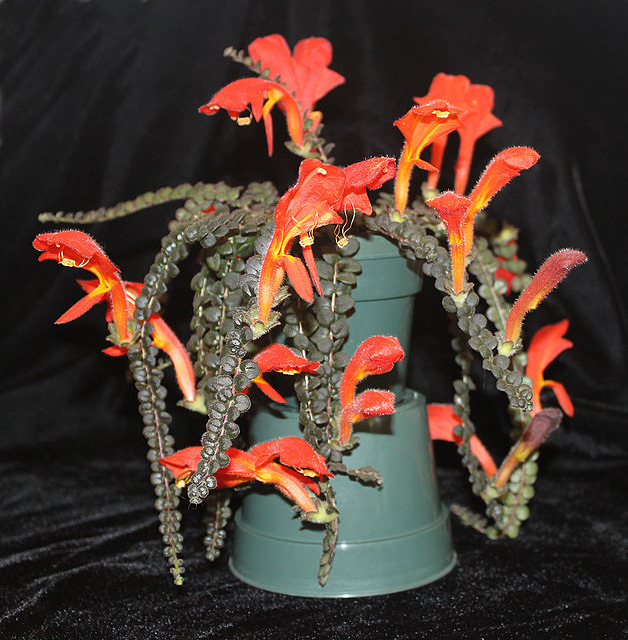
Columnea microphylla

This species and S. pusilla above both belong to the family Gesneriaceae, which contains a great many species well suited for growing indoors, of which the ubiquitous African violet is a familiar one. Columnea is a large genus with much variety, but Columnea microphylla has to be one of the most impressive. Again, it is not the largest plant (the one to the left looks like it’s in a 3″ pot), but the red flowers absolutely dwarf the leaves.

This species makes a great hanging basket plant, and the pendant stems will trail downward and show off their freakishly large flowers. This one will need a fair bit more light than the Sinningia above to bloom well, but won’t take up much space in a sunny window.

Stapelia gigantea

A first glance of the foliage and you might want to call this one a cactus, but not only is it not one of those, in fact its more familiar relatives are Hoyas, the tropical vines native to Asia commonly grown as houseplants, as well as the common milkweeds here in Ontario which are the chief food supply for monarch butterfly larvae. Stapelia is a genus restricted mostly to southern Africa, and so need a cooler rest period over the winter. making them a good candidate for a bright but poorly insulated bay window in a century home, say. The flowers can be up to a foot across, but have the unfortunate characteristic of reeking of rotting meat in order to attract flies, which are their natural pollinator. A beautiful plant to be sure, but I suppose not for the faint of heart; perhaps I should recommend that this one be brought outside in summer.

Lepanthes telipogoniflora

I’ve saved the best for last, and this little one is, to me, one of the most incredible orchid species out there, despite being only a couple inches across.

Lepanthes telipogoniflora is a diminutive orchid endemic to Colombia, where it grows in some of the wettest rainforest on earth (one spot once reported 43 FEET of rain in a year), which gives us a pretty fair hint as to how it should be kept in cultivation. Alas. I have personally killed this plant (twice); it understandably does not take to drying out in the slightest, and small plants are completely unforgiving. Enter again the terrarium; many people grow this plant successfully in those little round glass hanging terrariums that are quite easy to find these days, and as long as they’re kept happy (you’ll know it is so because the plant won’t be dead) they will bloom pretty consistently, with the flowers being relatively massive and at least the size of the plant in younger specimens. Another important cultural note is that they, as are many of the Pleurothallidinae orchids, are intolerant of hard water, and require rain or otherwise filtered water to do well. This species is, so far as I know, not produced by any Canadian orchid nurseries (presumably because of the aforementioned cultural challenges), but is brought in by Ecuagenera when they attend regional orchid shows here, and presumably by others as well.

This list of huge bloomers is by no means exhaustive; in fact, I’m sure I’ve only scratched the surface. If any other plants fit the bill, list them in the comments below!


A wild poinsettia: simply breathtaking. Image © Mark E. Olson, retrieved from his page about wild poinsettias, because I guess even the boring plants need their enthusiasts, and because there is a group working to determine from which population our common horticultural variety is derived.
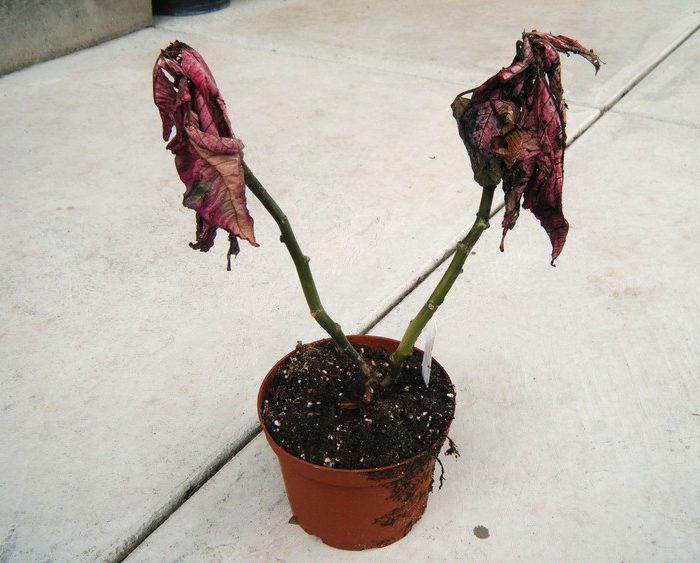
An all-too-frequent site; your typical poinsettia after Christmas. Image presumably © of and retrieved from the Hortophile blog.
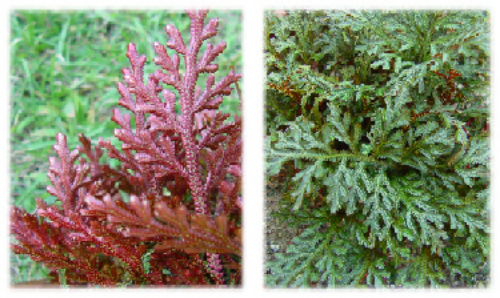
Selaginella erythropus, with photos showing the bottom and top of the leaves, respectively; a great prospective holiday plant, provided its need of high humidity can be met. Image © Black Jungle Terrarium Supply; image retrieved from their website.

You’ll recall in my other post entitled Why I Hate Orchids that I didn’t actually hate orchids at all, and in fact was pressing for better representation of the orchid family in commercial production. Not so for the title above: I actually do dislike these plants, and guess what? I’m not alone. Ask any professional horticulturist, and nine out of ten will make a screw face at the mere mention of the name. What follows below are a few reasons why I discourage anyone from supporting the perpetuation of this species as a holiday plant.

I’m not hating on the holidays here, and I’m glad that plants have their place therein, but let’s just all let poor Euphorbia pulcherrima fade out into horticultural history, to perhaps be rekindled at some point (hopefully long after I’m personally pushing up daisies) as a kind of quaint recollection of when we used to grow impossible, stupid plants for holiday decoration.

1. They’re bad for growers.

One of the world’s most economically significant potted crops they may be, but often growers will produce these plants at a financial loss to satisfy their customers. They are expensive to produce (as they’re not terribly easy to grow, cost an arm and a leg in feed, fungicide and equipment to shorten the day length in order to initiate flowering, and losses are high if the crop is poorly managed), demand a lot of care and the return is just not significant to really justify it beyond customer retention, etc. With margins already slim in ornamental production, it’s infuriating to see growers take an unnecessary hit for the sake of a .plant that few end users even have much long-term success with.

2. They’re unnatural

Well, they’re not, really, but they sure don’t look the way we’re used to in nature: picture, if you will, a stick, likely leaning against some other, more robust plant, with a couple leaves near the top, or else just the familiar red bracts, and there you have it (pretty much how they look if you forget to water them once, but don’t let them dry down enough to completely kill them). Not much to look at save when it’s ready to flower, and even then I can think of at least a handful of plants that do the same thing without all the fussiness and nonsense (many, many species of bromeliads, for example, will flush an intense red when ready to bloom).

I’m all for daring displays of horticultural prowess, and a well-grown poinsettia definitely is one, but it just doesn’t seem worth the work, particularly when it’s not doing its thing with the bracts; it’d be like having an out-of-flower Hibiscus or something for nine months out of the year.

3. They’re a pain in the ass to grow

All the way through, from rooting cuttings to maintaining finished plants in commercial or residential settings, these plants work against us and seem to want nothing more than to curl up and die. They resist at every turn our horticultural whims, and seem to seek to revert to their (to me, at least) unattractive wild form at the earliest chance. Skip a single watering and they’ll never forgive you for it, and will drop a goodly amount of leaves to remind you of what you’ve done.

They’re a magnet for whitefly, and growers spend a fortune in pesticides and Encarsia formosa, a parasitoid of whitely (and which can incidentally often be more effective in control of this pest than chemical treatments). They are also very prone to fungal diseases, and cost a small fortune in fungicides throughout the production cycle.

They demand a lot of light, and many times the best that you can hope for (especially in a commercial setting where the plants need to stay where they’ve been placed, regardless of distance from a nice south-facing window) is to just keep them from losing too much foliage by Christmas, as to expect them to actually grow is most of the time completely out of the question.

4. There are better holiday plants out there

Have a look at Gaultheria procumbens, a newer holiday crop that seems to be slowly gaining momentum. A deep rich green with red berries that screams holidays. It won’t kick the bucket nearly as quickly as poinsettia, though it is not necessarily a plant for long-term residence indoors, but that may be besides the point (how many poinsettias do you see by the side of the road on Boxing Day?) You don’t have to water it three times a week, and, perhaps more importantly, it actually draws attention and makes a bit of a statement.

And if it’s just red and green the people want, the list of plants is a long one indeed: red is a colour oft used by plants to draw pollinators (especially birds) to the plant to achieve pollination, as red contrasts heavily against a backdrop of green foliage. Many gesneriads such as Aeschynanthus and Columnea flower heavily with disproportionately large red flowers, and growers can easily time these for the holidays. There are also shade loving plants that have intense red on the undersides of their leaves: Selaginella erythropus, for example, would make a great holiday terrarium plant.

5. They’re boring

So boring, in fact, that we’ve had to resort to sparkles and spraypaint to keep them interesting. I don’t think there’s much more that needs to be said here, but they’re like the Dracaenas of the holiday season; they’re basically furniture, a decoration that just happens to be alive. I personally don’t give them much of a second glance, and neither does anyone I’ve asked.

So the question is; why do they persist? Tradition I can see is one of the driving factors, and old habits do die hard, but at what point will growers wipe the latex of their secateurs and call it quits for lack of any really tangible incentive to produce them? Will the market continue to demand these plants, particularly if the industry runs out of new ways to spin them (spray paint seems to be the end of the line, but maybe there’s still a trick up someone’s sleeve)? Are people prepared to pay more for them? Or will they be supplanted by a plant with more positive merits that still upholds the festive foliage like E. pulcherrima? I can only hope so, as I for one am ready for something different.

If you’re unfamiliar with the chemical reaction above, then you may also be unfamiliar with the fact that life as we typically tend to think of it would not be possible without plants.

Photosynthesis is responsible for the capture of solar energy that in turn powers nearly all life on earth: everything we eat is either plants, or other animals that formerly ate plants (or that ate other animals that ate plants). Plants absorb sunlight and convert it into chemical energy which is stored within the plant for its own uses; we eagerly exploit this by consuming them and thus the sum of the solar energy they’ve stored. Good deal for us, bad deal for the plants (not that they seem to care).

There are not many other ways to capture and metabolize energy in this way, save chemosynthesis (which is why I need to keep referring to ‘almost all life’ above, which, while definitely less dramatic, is more accurate, as there are organisms which are able to capture energy from chemical reactions, most notably in deep-sea communities colonizing hydrothermal vents, and so have no need of sunlight). So plants really are the foundation of nearly all life on the earth.

And not just regarding energy, either. Though a bit more oft-toted, the fact that plants maintain the planet’s oxygen levels is equally prevalent. This does bring up the subject of conservation, but I can save that for another time. I will add in a shameless plug, though, that plants indoors will raise local oxygen levels and just generally improve the air quality indoors. You can read this post for more information if you like: Plants at Work: The Science Behind how Plants Improve Life Indoors.

For anyone interested in the equation who doesn’t understand the chemistry, basically the plant takes 6 molecules of carbon dioxide and 6 of water, and splits these to create free oxygen (which is released by the plant), and a few other goodies which combine with the solar energy captured by the chlorophyll in the plant to create carbohydrates (the C6H1206 in the equation above) which contain that solar energy. Pretty simple, but critical to life on earth.

It’s a little humorous to me that our industry (speaking very broadly here, of course) provides, in a manner of speaking, a product that no one can live without. Maybe that’s why everyone tends to like plants so much: I’ve met many people indifferent to them (and have changed a few minds there), and many more people who love them but can’t seem to stop killing them (and I can only hope I’ve helped a bit there), but have never really met anyone who’s said that they actively dislike plants (except maybe recent victims of poison ivy or the like). Maybe it’s a stretch to assume that we as a species are that aware of the inexorable connection we have with the rest of life, but for whatever reason the biophilic instinct is certainly alive and well.

High-quality peat moss: note the large, fibrous-looking pieces. This is Lambert`s AFM soilless mix. Image © Lambert; retrieved from their website.
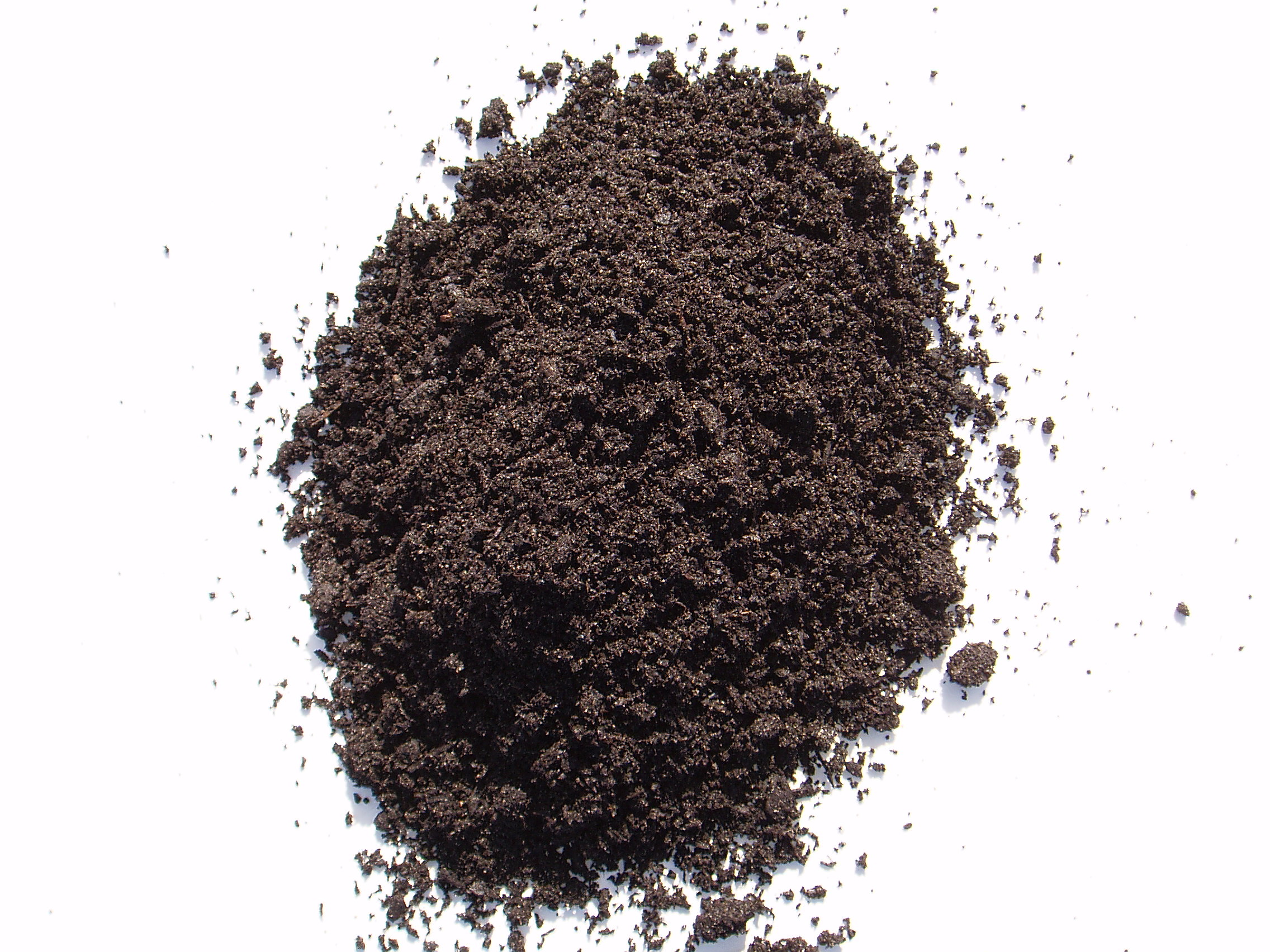
Low-quality peat moss: a photo of the dark, small-particled stuff that is sold at the consumer level. Image © unknown; retrieved (strangely) from LA Readers blog.
It's pretty tough to dispute the effect of a perched water table when it's captured in photos like this. Image © unknown, retried from The Garden Professors Blog

I had promised back in one of the parts of Watering 102 (see parts onetwo and three of that massive tome here) to write a little about growing media, and how to select or make one yourself in order to grow great plants. There are several aspects to consider that will help you make the best choice as far as what to use, and a lot depends on the type of plants you grow, how heavily/frequently you water, and environmental factors such as heat and humidity.

We’ll get this out of the way first, though: don’t ever call it dirt. Dirt is the stuff that ends up under our fingernails, and what we sweep off the floor. It’s something of a derogatory term, I feel. This is actually one of the first things that got drilled into us at horticulture school, and it stuck. We are all better off calling it soil, though even this is a bit of a misnomer, as what we typically use for indoor applications is a soilless growing media containing mostly organic material and no true mineral soil, such as you’d find in your backyard. ‘Soilless growing medium’ is a bit of a mouthful, though, so soil will suit our needs here.

First and foremost is peat moss. This material is partially decomposed sphagnum moss which comes in varying grades and qualities, and is the major component of most mixes, from the dusty garbage they sell you at the garden centre to the tried-and-true stuff used to produce countless acres worth of ornamentals of all sorts. When of an appreciable quality, it is best described as ‘fluffy’, and if you compare qualities side by side, the difference is striking. Quality peat is light in colour and feel and has varying larger particle sizes, which allows for good aeration. It also has a good water-holding capacity without becoming mud when very moist. It is relatively long-lived, though it does degrade over time. The other stuff is dense, with mostly small particle sizes, and is basically a more decomposed version of the nice stuff (being dredged from deeper in the peat bogs from which the material is drawn [the sustainability of which practice may come up in a future post]). It does become mud when you try and water it. It’s basically garbage, because it becomes a real challenge to ensure that a plant’s roots are able to absorb enough oxygen to keep from dying.

It’s important to make sure if you’re going to be purchasing straight peat moss for use in your own recipes that it is buffered: peat moss on its own is highly acidic (and is used as an amendment for acid-loving plants such as plants in the Ericaceae family such as blueberries), and bufffering will raise the pH from 4 or so up to about neutral (7), which is where most species will be best suited.

There is an alternate material to peat moss made from the husks of coconuts, called coir. It also comes in differing types, from roughly chopped husks to finely ground fibres. It is longer-lasting than peat, and also is less hydrophobic, meaning it will more readily absorb water when it is dry, which is handy. One serious issue is with the source of this material: as coir is processed it is often washed in seawater, and unless it is thoroughly cleaned can impart some serious saltiness to one’s plants, with the obvious devastating effect that you might expect. It is important to only buy this stuff from a reputable source (hydroponics stores usually stock it), or to process it yourself in order to ensure it is fit for use.

Perlite is usually the other component in soilless mixes. This is an expanded volcanic mineral which imparts greater aeration and water-holding capacity to the mix. It is not fertilizer, nor is it styrofoam, or anything else I’ve heard it being referred to as. It comes in varying sizes, with larger pieces being used for things like bark-based orchid media. It is admittedly ugly and unnatural looking, and has the bad habit of floating to the top of the container when watered heavily.

On that note, bark and sand are two more materials which can be found in some mixes, also in order to create more room for air in the growing medium. Sand is a bit outdated, but it’s cheap, and can be found in the dirt that’s marketed for cacti and succulents. Bark is more useful, but does break down eventually. Vermiculite is another mineral that is sometimes also used for enhanced water retention and aeration porosity. Other materials in specialty mixes are long-figer sphagnum moss, which is the undecomposed version of peat moss (you’ve probably seen orchids grown in this), and which greatly increases the water-holding capacity of a mix, tree fern fibre (a durable material derived from tropical tree ferns which creates a really nice open mix for things like epiphytes) and charcoal, which has little value past increaasing aeration porosity and its longevity.

So with that out of the way, basically what we’re looking for is a medium that provides the right mix of water-holding capacity to air-holding capacity for the type of plants we wish to grow, and for the amount of water we are applying. A decent basic soilless mix such as Berger’s BM6 contains about 75% peat to 25% perlite, and I’ve grown an extensive array of plants in this without any amendment. It can hold a lot of water if you let it, but it’s also a very good mix for keeping lightly moist, as it does drain quite freely. Again, if you let it go bone dry it will be difficult to rewet due to the hydrophobic nature of the peat, so bear that in mind. A lot of growers of gesneriads advise amending a mix like this to more of a 1:1 peat to perlite ratio, and while there’s definitely no harm to it, I’ve been able to grow most gesneriads I’ve worked with in just the basic mix by simply avoiding overwatering.

If you are heavy-handed with the watering can you may benefit from amending your mix, but there is such a thing as too light a mix as well. With increased aeration comes reduced water-holding capacity, and less than adequate watering can quickly lead to dessication. High temperatures and low humidity can also contribute to a more rapid drying of the media, and in some cases it may even be beneficial to have less aeration porosity in your mix: there are some unforgiving plants which are goners after they dry out even once (you’ll notice that the growing media of most ferns you see available, for example, do not even contain perlite).

How you use the mix will play a large role in how it performs. One of the most important things that needs your attention is that the media loses its functionality when it is crammed and forced firmly into the pot. While it does seem to hold a plant in place very well, this basically reduces all of those nice large spaces between soil particles that would ordinarily hold air, reducing them to a size that is then only capable of holding water. That’s bad news for plant roots, and maybe a bit of a slight to the hardworking folks who spend all that time developing and optimizing their professional growing media for the perfect aeration porosity. Slightly overfilling the container with soil and them watering the plant in gently but thoroughly will do wonders for securing the plant as the soil settles into itself, and the integrity of the mix will be preserved, allowing you (and of course, your plants) to take full advantage of its properties.

When watering these mixes, particularly when the container has been freshly planted, it is best to use a watering can or hose with a breaker in order to keep from disturbing the soil surface: in time, the soil’s microbiology will colonize the media and produce exudates which hold everything together nicely and make it easier to throw water on without having to worry too much about taking the extra time (good news for professionals).

Remember, too, that if you’re using any organic material at all, it will eventually decompose, and the soil will need to be changed. I won’t go into repotting here, but if you seem to have problems that could be explained by overwatering even though you’ve been doing everything the same way for a long while, decomposition of the media may be the issue.

A note on terrariums, particularly ones which actually have half a chance of success and aren’t just a few succulents thrown into a glass bubble because someone saw it on Pinterest (yes, I have a serious hate on for the current terrarium craze; so much so that I’ll likely rant aout it in another post): I want to draw your attention to the fabled ‘ABG mix’, one of a few substrate recipes whipped up by Atlanta Botanical Gardens for plants in their collection. This stuff has really caught on in the vivarium hobby (basically a planted terrarium that houses creatures like lizards or frogs), as it has perfect drainage and very long life, which are two things that can plague a planted glass enclosure. The mix commonly used is as follows:

1 part peat moss (or coir)

1 part milled sphagnum moss (ground or chopped long fiber sphagnum moss)

1 part fine horticultural charcoal

2 parts tree fern fibre

2 parts fine bark

You can have many years of enjoyment with this mix in the warm, humid conditions of a terrarium without it breaking down, and another bonus is that it looks way more natural than a peat/perlite container medium. If you play around with the ratios you can also create a great mix for houseplants that also resists decay and can allow you to go for quite some time without needing to repot due to substrate decomposition.

OK, one last thing about container media that has to do with drainage. There is an adage that many of you have no doubt heard about putting pot shards, gravel, or other material in the bottom of the container before filling with soil to allow for better drainage. This is a useless and counter-productive practice, and here’s why: because of the way water interacts with itself and with soil particles (cohesion and adhesion, respectively), it will not move readily from an area with small spaces between particles to one with large space between particles. The top of a layer of gravel or whatever is pretty much the same to water in soil as the bottom of the pot, so basically all you’re doing is eliminating valuable real estate for plant roots, and potentially creating conditions in which too much water is held in the soil because it’s not draining properly. Use the same medium throughout the container and you will generally have better results.

The photos to the left illustrate perfectly the effect of having a larger-particled substrate over a finer-particled one: the water distributes itself throughout the top layer and does not move into the layer below until fully saturated. The myth of drainage is one of those many things in horticulture that has just been repeated so often everyone thinks it must be true (and have a look at the comments on the page I grabbed the image from to see the type of stubbornness to change that is basically rampant in the scene, professional and amateur alike. This was another of the first things that we learned at school, and we did a whole whack of labs that really drove the point home for us.

So there it is, long-winded as ever. The takeaway points, I guess, are: don’t buy shitty quality soil, don’t cram it into the container, don’t bother trying to improve drainage with other materials, and don’t put succulent plants in terrariums.

Menu